Travelling in the wilderness
around Christianbury Crag
Kershope Forest
The Debatable Lands
Reiver Country:
Between Rowelltown
and Roadhead
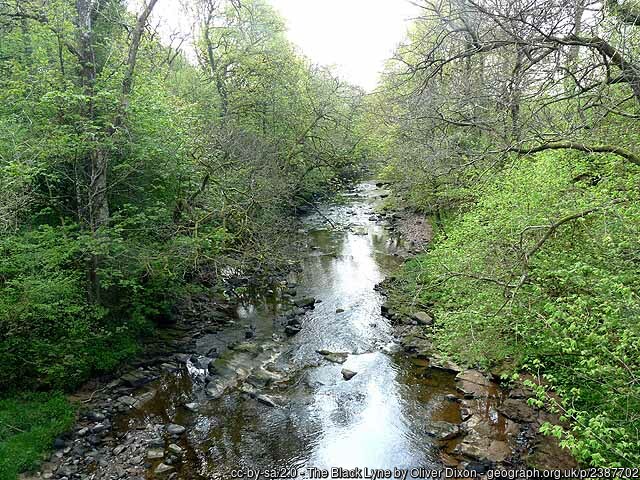
the Black Lyne and the White Lyne meet
like a divining rod
to form the River Lyne.
To make your way through the forest
where I once heard the first cuckoo in spring
so many years ago
you must follow the yellow markers on the trees
if you’re not skilled with map and compass, much like me
you could so easily get lost
and yet I loved it
for that very reason
– isn’t that
a little bit (even a lot) like life?
We wander through it
without map or a guide
and search for our divining rods
or yellow markers
to show us the way
before we realise that the divine
in us is our peculiar guide:
there are no black and white lines
in our minds and for this I do think,
it’s wildest there.
© Experimentsinfiction 2020, All Rights Reserved
Featured Image: Photo © Oliver Dixon (cc-by-sa/2.0)
About this poem
Writen for dVerse Poetics: travels in the wild. Sarah is hosting, and has given us a choice of lines with which to title our poem, all taken from the book ‘Surfacing’ by Kathleen Jamie. The first line immediately appealed to me, and I went for a walk with it.
Though a managed forest, the Kershope forest on the border between Cumbria, Northumberland and Scotland, has the feel of a true wilderness to me. It was once home of the infamous Border Reivers, in the debatable lands between England and Scotland, where the border was remarkably fluid and farms were often plundered by this band of outlaws in this untamed land. Many Reiver names survive in and around my native Cumbria, and some have spread all over the world, and even made it to the Moon (Armstrong is a Reiver name). The word ‘bereaved’ comes from the same route as the word ‘Reiver:’ ‘to reive’ meant ‘to rob or to plunder,’ and often in the case of these Borderers they would plunder the lives of those whom they robbed.
As for the names of the two tributary streams flowing into the River Lyne – I just love them, I think there’s something Lynchian about a landscape containing both a ‘Black Lyne’ and a ‘White Lyne.’
 Experiments in Fiction
Firstly.. the names of the places are true poetry, they add so much to the first part of the poem, then the thought of how life is with it’s urge to leave the yellow markers behind.
LikeLike
I, too, savored the names in your poem and the yellow marks reminded me of a story told to me by a great uncle, who said his family traveled through the forests from Arkansas to Illinois by following the “two blaze” trail, the blazes being marks made with ax by Daniel Boone, a famous explorer of the new west many years ago.
LikeLike
Beautiful poem and such an interesting supplement about the Reivers. I love that Armstrong’s line comes from them.
LikeLike
“the divine in us is our peculiar guide: there are no black and white lines in our minds and for this I do think, it’s wildest there.” I absolutely love, love this! 💝💝
LikeLike
we chose the same title and wrote very different poems that really say the same thing!
a lovely recall of the adventure that life is …
LikeLike
I agree – we are speaking the same language here 🙏
LikeLike
yours is more cultured, mine more blunt
LikeLike
There’s nothing wrong with being blunt, I often write that way too. Just felt like going for a walk last night!
LikeLike
you do cultured very well, I struggle with it!
LikeLike
Wonderful post, Ingrid! This park seems like a magical place to walk. i love the last two verses that compare this wandering to our internal wandering, and agree that our minds are a wilder place to explore. <3
LikeLike
Thank you, Cheryl: I’m pleased this resonated with you ❤️
LikeLike
This is a very wonderful poem! “No black and white lines in our minds”
LikeLike
Thank you Mary, I am pleased it spoke to you.
LikeLike
Wow! Such beauty.
LikeLike
Thanks Lucy 😊
LikeLike
You took us on a smooth ride to the places you referenced. Well done, Ingrid!
LikeLike
Thanks Eugenia 🌲
LikeLike
Most welcome, Ingrid!
LikeLike
Ok now those were some tonque twsiters, I was getting lost in just with the names of the forrest and the rivers and places and I agree with you.. skip the map and enjoy the journey.. nice poem! ❤️
LikeLike
Haha, Cindy – I didn’t even think how these place names might look to someone who is not from the area 😅 maybe I should add an audio…because when I hear it in my head it makes sense 🤣
LikeLike
It all makes sense and it was awesome; just wild. Yeah do it; we love to hear your voice!💕
LikeLike
WOW I loved the line “before we realise that the divine / in us is our peculiar guide” and we’ve chosen the same title :)) An amazing coincidence!
LikeLike
Thanks for this, Ingrid. Reminded me so much of the Woden Walks that have slipped away this year. We never made it out to Cumbria (although I have good memories of time spent in Kielder & Bellingham – is that Cumbria?), but we certainly headed west from here, north, too. The countryside only becoming more… more! The bastle houses and the Reiver histories up around Haltwhistle and Tarset being of particular interest. Thanks again xo
LikeLike
You’re most welcome! Kielder spans these Borderlands between Nothumberland, Cumbria and Scotland too. The Kershope forest kind of blends in to Kielder. I love the Lake District but this place is more bleak, barren and wild.
LikeLike
‘The Debatable Lands
Reiver Country’
Some of my family came from the Border area, the Forsyths. I don’t think they were raiders or reivers, however. I like the way you weave this towards us all being lost, to some degree, within ourselves, analogous if you like.
LikeLike
This is the kind of wilderness I am more than happy to walk in, Ingrid. Rugged and beautiful with magical names. Although I live in the flatlands of Norfolk, I do love curvaceous landscapes with lots of trees. Cumbria is one of the places on my list to visit once we are allowed to roam free again. I enjoyed the background history and etymology in your notes. In your poem, I especially love ‘the Black Lyne and the White Lyne meet / like a divining rod’ and
‘We wander through it
without map or a guide
and search for our divining rods
…
before we realise that the divine
in us is our peculiar guide’.
LikeLike
I’m pleased you enjoyed my wanderings, Kim. I know I’m biased, but Cumbria is a wild and wonderful place!
LikeLike
You really went venturing with this poem Ingrid – was wonderful to follow all the footstepping here and find the spirit that guides within
LikeLike
Thank you, Laura – I did enjoy the walk!
LikeLike
A lovely poem Ingrid and a nice image to go with it.
LikeLike
Thanks Hobbo – I found that on the internet on some kind of geography site!
LikeLike
You mark a clear path both through the land and in our minds. (K)
LikeLike
That was a journey with insight. I loved hearing about the border country, the ‘debatable’ lands. Words and names carry such rich history with them.
LikeLike
They do indeed! Thank you Jane 😊
LikeLike
:)
LikeLike
This was so very engaging Ingrid. I liked the trek you took me on, a fascinating journey. Not being overly rigid in our approach to life, being willing to wander full of wonder is for me the beauty of spontaneity that makes life rich
LikeLike
I love “the divine in us is our peculiar guide” and the wildness within…………wonderful!
LikeLike
Thank you Sherry 😊
LikeLike
This metaphor of life as an unguided walk is so true. There may be guideposts and indications of where to head, but reaching our goal is just as much about our perspective in getting there.
LikeLike
This sounds like a wonderful wild area! A great poem with wonderful images and analogies…
you could so easily get lost
and yet I loved it
for that very reason
– isn’t that
a little bit (even a lot) like life?
LikeLike
I love this. It’s like a road-map-list-poem. What a splendid way to describe a ramble.
LikeLike
Awesome post!! Inspires me to get outdoors!
LikeLike
Thank you!
LikeLike
You’re very welcome!
LikeLike